Cover Design Philosophy

Design Concept
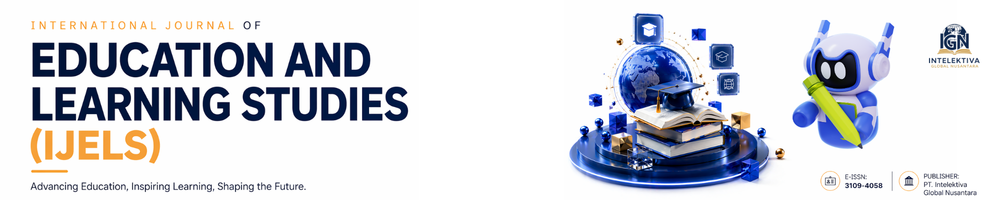
The cover design of the International Journal of Education and Learning Studies (IJELS) reflects the transformation of education within a dynamic, interconnected, and globally oriented digital era.
Each visual element is intentionally composed to represent the evolution of learning, the construction and expansion of knowledge, technological advancement, scholarly openness, and the journal's position within the international academic landscape. The design combines educational symbolism, digital aesthetics, and contemporary visual language to establish a professional and recognizable scholarly identity.
The cover communicates that education is not a static process, but a continuous, multidimensional, collaborative, and technology-supported journey through which knowledge is developed, shared, evaluated, and transformed.
1. Dominant Blue Color and Gradient Transitions
- The dominant blue color symbolizes trust, credibility, stability, intelligence, and intellectual depth within academic discourse.
- Blue also represents the journal's commitment to professionalism, scholarly integrity, and responsible knowledge dissemination .
- The gradual color transitions illustrate the learning journey from foundational understanding toward advanced, complex, and transformative knowledge .
2. Three-Dimensional Educational and Geometric Elements
- The books and graduation cap represent formal education, academic achievement, intellectual growth, and the transmission of knowledge .
- Three-dimensional geometric forms symbolize knowledge as something that is constructed, interconnected, multidimensional, and continually refined .
- The spatial arrangement of the elements reflects the interaction among theory, research, technology, teaching, and learning practice .
3. Digital Globe and Network Connections
- The digital globe represents international collaboration, global academic exchange, and the worldwide dissemination of educational research .
- Network connections symbolize the interdependence of researchers, educators, institutions, disciplines, and communities .
- These elements emphasize that contemporary education operates within a borderless, collaborative, interdisciplinary, and digitally connected ecosystem .
4. Glassmorphism and Transparency Effects
- Transparent visual layers symbolize openness, accessibility, accountability, and transparency in scientific knowledge.
- The overlapping translucent forms represent the way ideas, theories, data, and perspectives interact in the development of new knowledge.
- This design approach aligns with the principles of open science, open access, ethical publishing, and responsible scholarly communication .
5. Dynamic Lines and Light-Wave Patterns
- Dynamic lines and light-wave patterns represent the continuous movement, circulation, and evolution of knowledge .
- Their flowing direction reflects the ongoing transformation of educational thought, research methods, learning environments, and pedagogical practice.
- These visual elements emphasize that learning is a lifelong, adaptive, reflective, and future-oriented process .
6. Minimalist Layout and Typographic Hierarchy
- The minimalist composition reflects professionalism, clarity, precision, and high academic standards .
- A clear typographic hierarchy improves readability and ensures that the journal title and publication identity remain visually prominent.
- The balanced arrangement strengthens the journal's scholarly authority, consistency, recognizability, and international orientation .
Visual Synthesis
Represented through books, academic symbols, and the graduation cap.
Represented through interconnected three-dimensional geometric forms.
Represented through the digital globe and network connections.
Represented through transparency, layered forms, and open visual space.
Represented through dynamic movement, light waves, and visual transitions.
Represented through the disciplined layout, typography, and color consistency.