Focus and Scope
1. Journal Focus
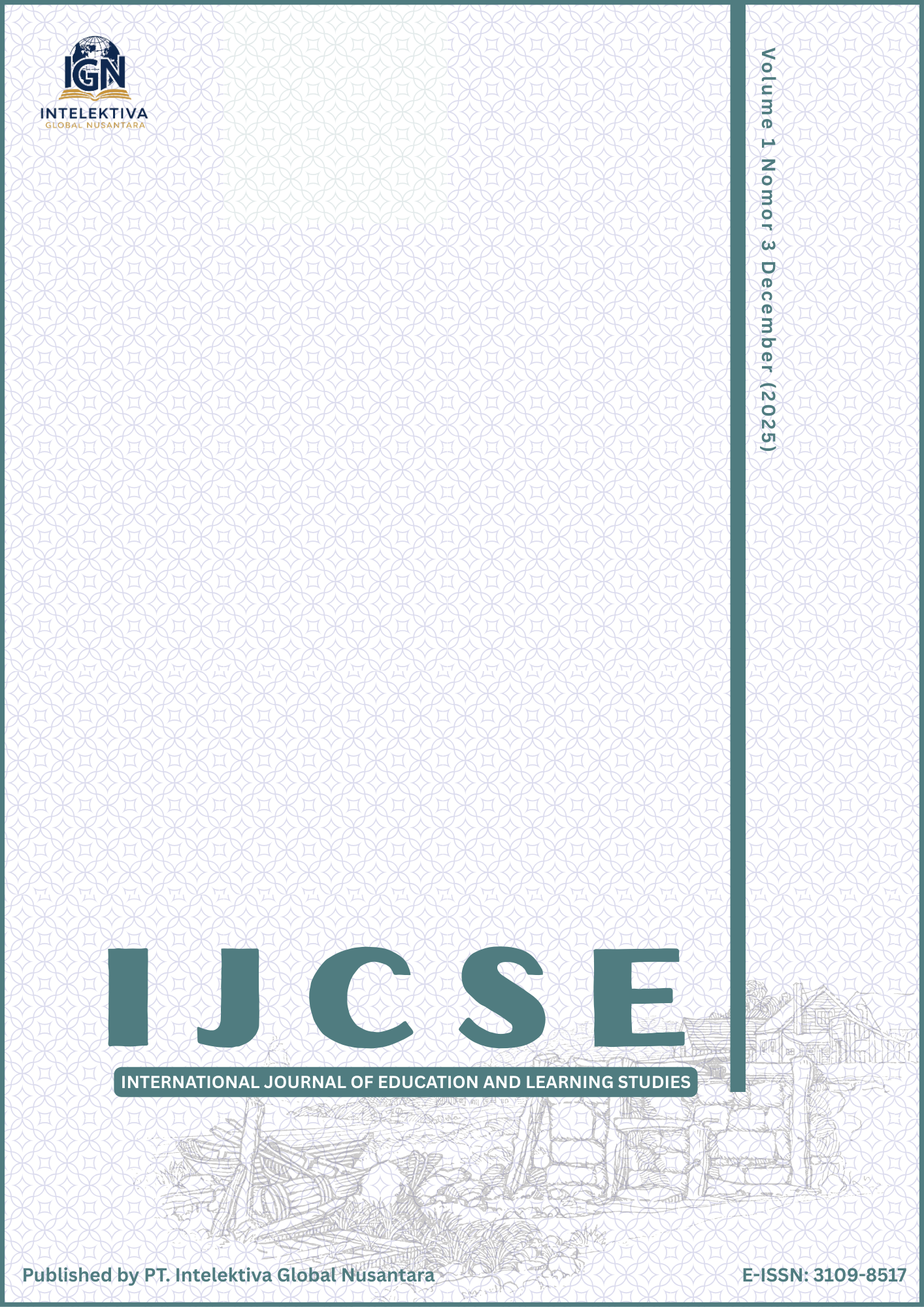
The International Journal of Education and Learning Studies (IJELS) is an international, peer-reviewed, open-access scholarly journal established in 2025 and published by PT. Intelektiva Global Nusantara.
IJELS publishes original research and scholarly reviews that advance educational theory, research, policy, and practice across diverse educational levels, disciplines, and learning environments.
The journal places particular emphasis on rigorous, theoretically informed, and evidence-based investigations into teaching and learning processes, curriculum and instruction, educational technology, learner development, assessment, teacher education, and educational improvement.
IJELS aims to strengthen the relationship between educational research and practical implementation by disseminating scholarship that contributes to international academic dialogue and meaningful improvements in educational systems and practices.
IJELS is published three times annually, in April, August, and December.
2. Manuscript Categories
Empirical studies presenting original findings and meaningful contributions to educational scholarship. The journal welcomes appropriate quantitative, qualitative, mixed-methods, experimental, quasi-experimental, developmental, and other rigorous research designs.
Systematic reviews, scoping reviews, bibliometric analyses, integrative reviews, and critical reviews that use clearly explained analytical procedures to synthesize educational literature, evaluate existing evidence, identify research gaps, and establish meaningful directions for future scholarship.
3. Areas of Scope
IJELS welcomes manuscripts addressing the following interconnected areas of educational research:
Instructional strategies, classroom interaction, student engagement, active learning, and evidence-based pedagogical practices.
Curriculum design, development, implementation, evaluation, instructional planning, and curriculum reform.
Digital learning environments, artificial intelligence in education, online learning, educational applications, and technology-supported instruction.
Preservice teacher preparation, professional learning, pedagogical competencies, mentoring, and teacher development.
Innovative pedagogical models, learning design, educational development research, and classroom-based innovations.
Learning motivation, cognitive and socio-emotional development, learner differences, self-regulation, and educational behavior.
Educational governance, policy implementation, school improvement, leadership, and educational management.
University teaching, student learning, academic development, higher education policy, and institutional quality.
Early learning, child development, play-based pedagogy, and early childhood educational practices.
School-based teaching, learning outcomes, educational transitions, and instructional improvement.
Science, technology, engineering, mathematics, computational thinking, and interdisciplinary STEM learning.
Educational measurement, learning assessment, evaluation models, formative assessment, and assessment literacy.
Inclusive pedagogies, disability support, equitable access, and diverse learner needs.
Literacy development, mathematical learning, language instruction, and foundational competencies.
Continuing education, workplace learning, adult education, and lifelong learning policies and practices.
4. Article Expectations
Manuscripts submitted to IJELS are expected to:
- Address a clearly defined educational problem or scholarly question.
- Demonstrate relevance to the journal's focus and scope.
- Present a coherent theoretical, conceptual, or empirical foundation.
- Employ an appropriate and transparently reported methodology.
- Provide reliable empirical findings or rigorous scholarly synthesis.
- Explain the originality and significance of the scholarly contribution.
- Discuss relevant implications for educational research, policy, and practice.
- Comply with the journal's publication ethics and author guidelines.
5. Manuscripts Outside the Journal Scope
IJELS generally does not consider manuscripts that lack a substantive educational research focus, consist solely of descriptive opinion without scholarly analysis, present unsupported claims, or offer purely technical developments without meaningful implications for education and learning.
Manuscripts that do not demonstrate appropriate methodological rigor, scholarly contribution, or alignment with the journal's aims may be declined during initial editorial screening.
6. International Orientation
IJELS welcomes contributions from researchers, academics, educators, graduate students, educational practitioners, and policymakers worldwide.
Comparative, cross-cultural, interdisciplinary, and contextually grounded studies are encouraged, provided that they make meaningful contributions to broader educational scholarship.
7. Submission Information
Authors should consult the journal's current Author Guidelines for manuscript structure, formatting, citation requirements, required submission documents, and publication ethics.
View IJELS Author Guidelines →
IJELS promotes original, methodologically sound, theoretically informed, and ethically responsible scholarship that advances educational knowledge and supports evidence-based improvements in teaching, learning, policy, and educational practice across diverse contexts.