Open Access Policy
1. Open Access Statement
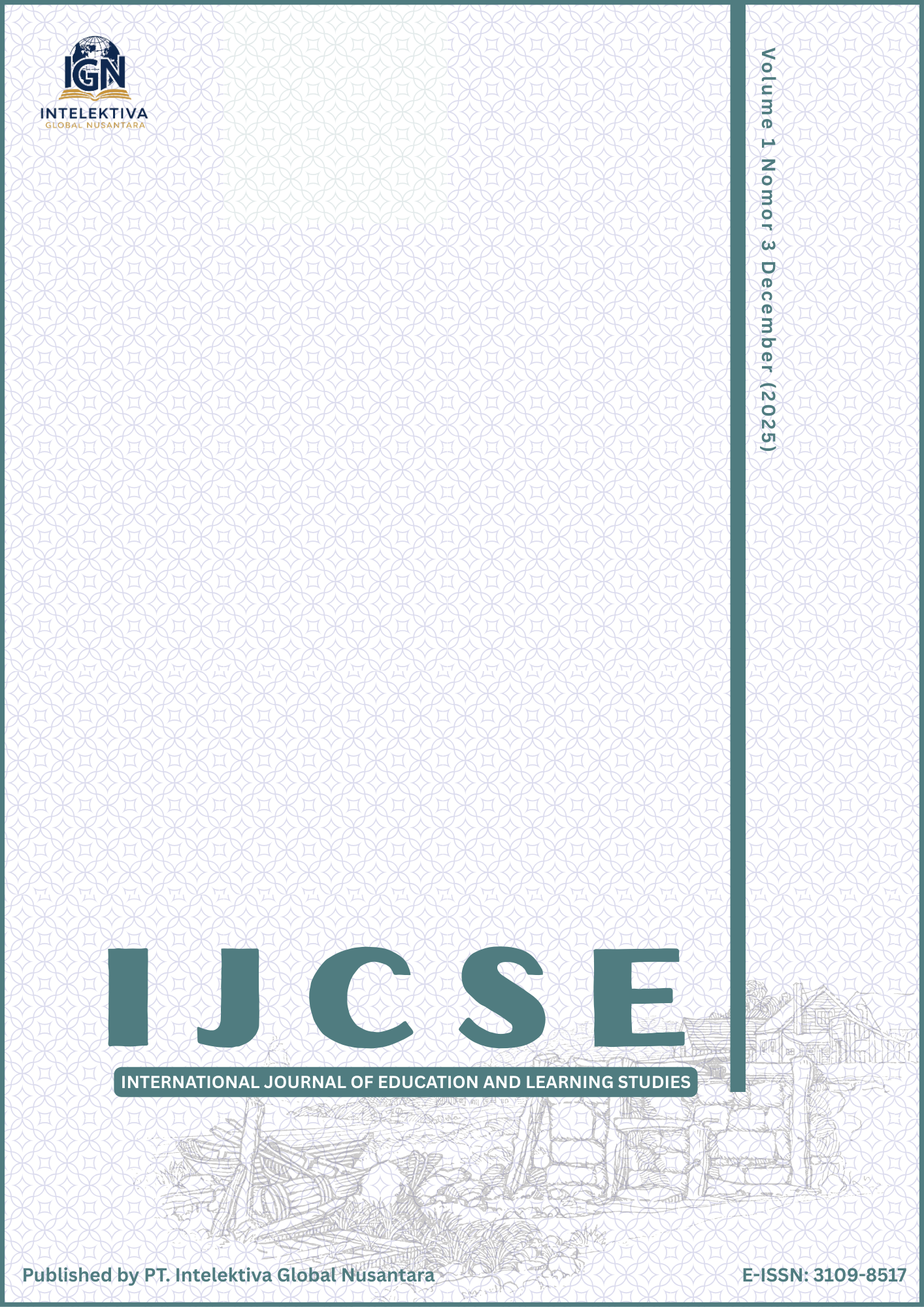
The International Journal of Education and Learning Studies (IJELS), published by PT. Intelektiva Global Nusantara, is a fully open-access scholarly journal. All published articles are made immediately and freely available online without subscription fees, reader registration requirements, paywalls, or embargo periods.
IJELS supports the principles of the Budapest Open Access Initiative (BOAI) and promotes the open-access principles recognized by the Directory of Open Access Journals (DOAJ).
The journal seeks to remove unnecessary financial, legal, and technical barriers to accessing and lawfully reusing scholarly publications, thereby supporting international collaboration, educational development, and the equitable exchange of knowledge.
2. Immediate and Free Access
- All scholarly articles are freely available immediately upon publication.
- No subscription or reader registration is required.
- No embargo period is applied to published scholarly content.
- Readers are not required to pay fees to access or download articles.
- Articles may be lawfully shared and reused under their applicable open license.
3. Creative Commons License
All scholarly articles published in IJELS are distributed under the Creative Commons Attribution–ShareAlike 4.0 International License (CC BY-SA 4.0), except for third-party material expressly identified as excluded from the article's open license.
This license permits users to share, copy, redistribute, translate, adapt, remix, and build upon licensed content for any lawful purpose, including commercial purposes, subject to the applicable license conditions.
View the CC BY-SA 4.0 License4. Rights of Readers and Other Users
Under the applicable open license, readers and other users may:
- Read, download, save, and print published articles.
- Copy and redistribute licensed scholarly content in any medium or format.
- Share articles with individuals, educational institutions, and research communities.
- Search and link to the full text of publications.
- Translate, remix, transform, or adapt licensed content.
- Use articles in teaching, scholarly research, professional activities, and commercial applications.
- Include licensed content in repositories and educational resources.
- Conduct lawful text and data mining.
- Use licensed article content in software-supported scholarly analysis.
5. License Conditions
Users must provide appropriate credit to the original author(s), identify the source of publication, include a link to the license, and indicate changes where applicable. Attribution must not imply endorsement by the authors or journal.
When distributing adapted material, users must license their adapted contributions under CC BY-SA 4.0 or another license permitted by its ShareAlike compatibility provisions.
Users must indicate modifications, translations, or other adaptations when sharing altered material.
Users may not impose additional legal terms or technological measures that prevent others from exercising rights granted under the license.
6. Copyright Ownership and Publishing Rights
Authors retain copyright and full publishing rights to their scholarly articles without transferring copyright or granting exclusive publishing rights to IJELS or its publisher.
Authors grant IJELS a non-exclusive right of first publication and permission to publish, disseminate, archive, preserve, and index the official Version of Record in accordance with the journal's licensing arrangements.
Copyright terms applied to scholarly articles are distinct from any intellectual property rights associated with the journal's website, logo, design, or publisher-owned material.
7. Repository and Self-Archiving
IJELS permits authors to deposit the submitted manuscript, accepted manuscript, and published Version of Record in institutional repositories, subject repositories, academic websites, or other scholarly dissemination platforms.
No embargo period is imposed by IJELS on author self-archiving.
Authors are encouraged to identify the manuscript version and provide a link to the final published article, preferably through its DOI where available.
8. Indexing, Crawling, and Text and Data Mining
IJELS permits scholarly search engines, indexing services, institutional repositories, academic databases, and preservation systems to access, crawl, harvest, index, and analyze publicly available scholarly metadata and licensed article content for lawful purposes.
The journal supports lawful text and data mining, automated discovery, and machine-assisted analysis in accordance with applicable licenses and technical standards.
Such permission does not constitute a guarantee of technical availability, indexing acceptance, or inclusion in any particular bibliographic database.
9. Third-Party Materials and Reuse
Materials owned by third parties, including photographs, figures, illustrations, datasets, or copyrighted instruments, may be subject to different permissions or legal conditions.
Any material excluded from the article's CC BY-SA 4.0 license must be clearly identified through a copyright notice or appropriate credit line. Users must respect applicable third-party rights, privacy obligations, and lawful limitations.
10. Licensing Transparency and Publication Metadata
IJELS identifies the applicable license and copyright holder on the journal website and aims to communicate this information consistently through article landing pages, full-text publications, and relevant metadata.
The journal's open-access policy, copyright policy, and publishing arrangements must remain consistent and must not introduce restrictions that contradict the CC BY-SA 4.0 license.
11. Open Access References
IJELS is committed to immediate, equitable, and sustainable access to scholarly knowledge. Its CC BY-SA 4.0 licensing policy supports lawful sharing, adaptation, discovery, and reuse while preserving the authors' copyright and the integrity of the scholarly record.